
For 2027, one in five individual Medicare Advantage plans offers no cover at all for emergencies abroad, up from one in twenty this year. Our analysis of the federal government’s own plan data shows that the number of plans with worldwide emergency and urgent care cover falls from 5,330 to 4,453. Most plans keep the benefit, but if you travel it is worth checking whether yours is one of those that has changed.
Each plan has set out its changes in the Annual Notice of Change sent to members by 30 September. Anyone who travels, winters abroad or visits family overseas has until 7 December 2026 to decide what to do about it.
Why the Annual Notice of Change matters
Every Medicare Advantage plan must tell its members, in writing, what will change in the coming year. This letter is the Annual Notice of Change. Federal rules require changes that take effect on 1 January to reach members 15 days before the enrolment period opens, which means by 30 September (42 CFR 422.111).
The notice gives members time to compare plans during the Annual Enrollment Period, which runs from 15 October to 7 December 2026 (Centers for Medicare & Medicaid Services). Members who miss it have a second, narrower chance to switch between 1 January and 31 March (Indiana State Health Insurance Assistance Program).
Cover abroad matters because Original Medicare generally does not pay for health care outside the United States, apart from a few narrow exceptions (Medicare.gov). Medicare Advantage plans can choose to add worldwide emergency and urgent care as an extra benefit. Until now, almost all of them did.
What the data shows
The share of individual Medicare Advantage plans offering worldwide emergency cover falls from 95.2% in 2026 (5,330 of 5,599 plans) to 80.1% in 2027 (4,453 of 5,561 plans). Of the 5,330 plans that offered the cover this year, 696 have removed it entirely and 507 have kept it on worse terms.
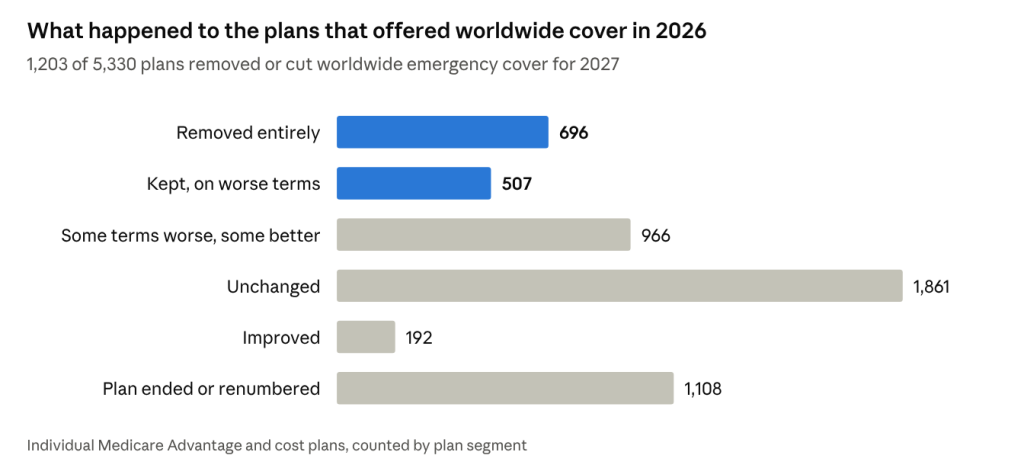
ExpatInsure analysis of Centers for Medicare & Medicaid Services Plan Benefit Package files, 2026 and 2027.
Insurers review their supplemental benefits every year. For 2027, some insurers have removed worldwide emergency and urgent care cover from all of their individual plans. Their Annual Notices of Change now state that emergency care, including emergency ambulance services, and urgently needed services outside the United States are not covered, and suggest that members who travel consider a separate travel medical insurance policy. Our analysis covers individual plans only: employer and retiree group plans were not included and may still provide worldwide cover, so members of those plans should check their own plan documents.
Among insurers that have kept the benefit, some have changed what members pay to use it. Listed alphabetically:
| Insurer | Plans with worldwide cover, 2026 | What changes for 2027 |
|---|---|---|
| Aetna Medicare | 634 | 390 plans unchanged; 107 plans with higher emergency transport or emergency room copays |
| Devoted Health | 427 | 316 plans unchanged; 71 plans with higher emergency transport copays, up to $375 |
| HealthSpring | 224 | Emergency transport moves from a flat $110 to $150 copay to 20% coinsurance on its 175 continuing plans |
| Humana | 849 | Emergency transport copay of $325 on 645 plans; urgent care copay lower, typically $40 to $65 |
| Kaiser Permanente | 117 | 68 plans with higher copays, including emergency transport copays of up to $630 |
| SCAN Health Plan | 72 | 33 plans with higher emergency copays, mostly from $90 to between $115 and $150 |
A smaller group has lowered the maximum the plan will pay abroad. Medical Mutual of Ohio halves its cap from $50,000 to $25,000 on 12 plans, and Select Health introduces a $150,000 cap on 10 plans that previously had no limit. HealthSpring plans were sold in 2026 under the brand of the previous owner of that business, which Health Care Service Corporation bought in March 2025 (Healthcare Finance News).
What this means if you travel
If your plan no longer includes worldwide cover, from 1 January 2027 it will not pay for an emergency room visit, urgent care or an ambulance outside the United States, so the cost of a fall on holiday or a sudden illness while visiting family abroad would fall to you. If your cover comes through a former employer or union, it may be different, so check your own plan documents.
“Many older Americans travel abroad expecting their Medicare Advantage plan to cover them in an emergency. It could be the case that the first you know about these changes is your Annual Notice of Change, so please make sure you read it. Check whether your plan still includes worldwide cover for 2027 and, if it does not, think about how you will be protected before your next trip.”
Chris Carter, Founder and Chief Executive Officer, ExpatInsure
Members of other plans should read the worldwide cover section of their own Annual Notice of Change. Check three things: whether the benefit is still included, the maximum the plan will pay abroad, and the copay for emergency transport, which is where most of the increases fall.
Depending on your circumstances, the main options before 7 December 2026 are:
- Compare Medicare Advantage plans that keep worldwide cover. Four in five plans still include it, although the terms vary widely.
- Consider Original Medicare with a Medigap policy. Medigap Plans C, D, F, G, M and N pay 80% of emergency care abroad after a $250 yearly deductible, up to a $50,000 lifetime limit, for emergencies that begin in the first 60 days of a trip (Indiana State Health Insurance Assistance Program).
- Keep your plan and add travel medical insurance for each trip. This may suit people who are otherwise happy with their plan. Medicare.gov itself suggests travel insurance for more cover abroad, while warning that not every travel policy includes health cover (Medicare.gov).
- Consider an annual worldwide travel medical policy if you travel several times a year or spend winters abroad.
Your State Health Insurance Assistance Program offers free, impartial counselling on Medicare choices.
If travel medical insurance would help, ExpatInsure can show you the options. Our travel medical insurance page sets out single-trip, annual worldwide and group cover available to United States residents, including single-trip plans and worldwide plans from Blue Cross Blue Shield Global Solutions. Our guide to travel insurance versus health insurance explains the difference, and you are welcome to book a call with one of our advisers. For those spending more than six months a year abroad, international health insurance may be more suitable, and you can request a quote.
ExpatInsure may receive a commission if you buy through these links. Availability, terms, conditions and exclusions vary by plan and by state of residence.
State by state
Florida has the largest fall in the country: 104 fewer plans offer emergency cover abroad in 2027, down from 590 to 486, a fall of 18%. Texas follows, with 87 fewer, a fall of 22%. The steepest falls are in New Mexico, where the number of plans with cover drops by 59%, from 68 to 28, followed by North Dakota (54%), the District of Columbia (47%) and Rhode Island (45%). Only Alabama, Puerto Rico, Tennessee and Vermont have the same number of plans with cover, or more.
| State | Plans with cover, 2026 | Plans with cover, 2027 | Change in plans with cover | Change (%) |
|---|---|---|---|---|
| Alabama | 92 | 92 | 0 | 0% |
| Arizona | 124 | 117 | −7 | −6% |
| Arkansas | 84 | 69 | −15 | −18% |
| California | 383 | 332 | −51 | −13% |
| Colorado | 97 | 78 | −19 | −20% |
| Connecticut | 44 | 39 | −5 | −11% |
| Delaware | 34 | 28 | −6 | −18% |
| District of Columbia | 19 | 10 | −9 | −47% |
| Florida | 590 | 486 | −104 | −18% |
| Georgia | 153 | 133 | −20 | −13% |
| Hawaii | 41 | 35 | −6 | −15% |
| Idaho | 47 | 27 | −20 | −43% |
| Illinois | 150 | 111 | −39 | −26% |
| Indiana | 118 | 110 | −8 | −7% |
| Iowa | 67 | 49 | −18 | −27% |
| Kansas | 84 | 61 | −23 | −27% |
| Kentucky | 108 | 95 | −13 | −12% |
| Louisiana | 106 | 96 | −10 | −9% |
| Maine | 51 | 39 | −12 | −24% |
| Maryland | 42 | 29 | −13 | −31% |
| Massachusetts | 94 | 80 | −14 | −15% |
| Michigan | 185 | 162 | −23 | −12% |
| Minnesota | 72 | 46 | −26 | −36% |
| Mississippi | 89 | 80 | −9 | −10% |
| Missouri | 144 | 134 | −10 | −7% |
| Montana | 32 | 20 | −12 | −38% |
| Nebraska | 51 | 36 | −15 | −29% |
| Nevada | 105 | 78 | −27 | −26% |
| New Hampshire | 17 | 13 | −4 | −24% |
| New Jersey | 79 | 55 | −24 | −30% |
| New Mexico | 68 | 28 | −40 | −59% |
| New York | 203 | 183 | −20 | −10% |
| North Carolina | 157 | 133 | −24 | −15% |
| North Dakota | 24 | 11 | −13 | −54% |
| Ohio | 199 | 140 | −59 | −30% |
| Oklahoma | 79 | 60 | −19 | −24% |
| Oregon | 91 | 76 | −15 | −16% |
| Pennsylvania | 316 | 302 | −14 | −4% |
| Puerto Rico | 63 | 63 | 0 | 0% |
| Rhode Island | 22 | 12 | −10 | −45% |
| South Carolina | 87 | 79 | −8 | −9% |
| South Dakota | 23 | 19 | −4 | −17% |
| Tennessee | 122 | 123 | +1 | +1% |
| Texas | 398 | 311 | −87 | −22% |
| Utah | 53 | 36 | −17 | −32% |
| Vermont | 3 | 5 | +2 | +67% |
| Virginia | 136 | 106 | −30 | −22% |
| Washington | 123 | 85 | −38 | −31% |
| West Virginia | 64 | 53 | −11 | −17% |
| Wisconsin | 111 | 80 | −31 | −28% |
| Wyoming | 14 | 8 | −6 | −43% |
A plan is counted in every state where it is sold. Around 40 regional plans whose service areas are not listed by county are not included in this table.
How we did the analysis
ExpatInsure analysed the Plan Benefit Package files that the Centers for Medicare & Medicaid Services publishes for 2026 and 2027. Every plan files its benefits in this standard format, and the same data populates Medicare Plan Finder. The Annual Notice of Change is, in effect, each plan’s written summary of the differences between its two filings.
- Scope: Individual Medicare Advantage and cost plans, counted by plan segment. Employer-only plans, stand-alone drug plans and the Program of All-Inclusive Care for the Elderly are excluded. This gives 5,599 plans for 2026 and 5,561 for 2027, in line with the 5,553 and 5,532 plans reported by the Centers for Medicare & Medicaid Services.
- Worldwide cover: The plan’s answer to the federal question of whether it provides worldwide emergency and urgent coverage as a supplemental benefit, with its maximum benefit, copays, coinsurance and deductible.
- Matching: Plans are compared where the same plan number continues into 2027. A further 1,154 plans ended or were renumbered; without the federal plan crosswalk we cannot say what cover their members move to, so they are not counted as cuts.
- Limits: The figures count plans, not people, because the membership field in this data is blank for almost all plans. Benefits filed with the federal government can occasionally be corrected after publication.
The full plan-by-plan results are available from ExpatInsure on request.
Sources
- Centers for Medicare & Medicaid Services, Plan Benefit Package benefits data, 2026 and 2027
- Centers for Medicare & Medicaid Services, press release on 2027 Medicare Advantage and prescription drug plans, 28 September 2026
- Electronic Code of Federal Regulations, 42 CFR 422.111, disclosure requirements
- Medicare.gov, Travel outside the United States
- Indiana State Health Insurance Assistance Program, Medigap foreign travel emergency cover and annual enrolment dates
- Healthcare Finance News, Health Care Service Corporation launches HealthSpring brand
- ExpatInsure, Travel medical insurance, Worldwide travel insurance guide and Travel insurance versus health insurance